 Tampa Window
 Valrico's Climate Is Hard on Siding — Here's Why
Valrico sits inland from Tampa Bay in Hillsborough County, but "inland" doesn't mean sheltered. Homes here still take the same punishment as the rest of the Tampa Bay region: long stretches of intense UV exposure, humidity that never really lets up, sudden downpours that drive rain sideways during summer storms, and the real possibility of hurricane-force wind gusts during the June-through-November storm season. Add in the freeze-thaw-free but heat-cycle-heavy climate — siding here expands and contracts through blistering afternoons and cooler nights nearly year-round — and you have a set of conditions that most exterior products simply weren't engineered to handle long-term.
Wood-based and wood-alternative siding products absorb moisture, swell, and eventually rot or delaminate under this kind of repeated wet-dry cycling. Vinyl siding softens, warps, and can pull away from the wall in sustained high winds. Even products that hold up reasonably well in drier, more moderate climates often underperform once they're installed on a Tampa-area home and left to face a full hurricane season. Fiber cement siding — specifically James Hardie's climate-engineered product lines — was developed with exactly this kind of exposure in mind, which is a major reason it's the only siding system we install on Valrico homes.
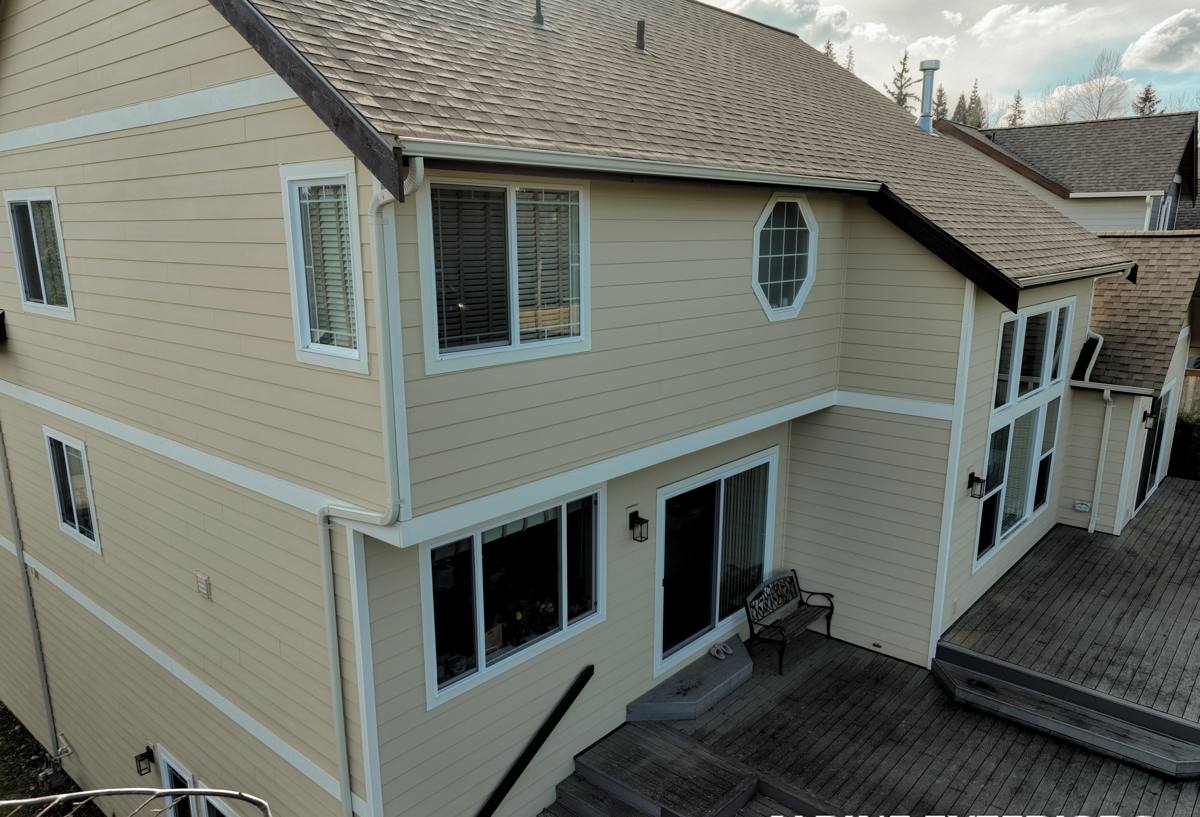
What Valrico Homes Specifically Need From Their Siding
Every siding job in this part of Hillsborough County has to answer a few non-negotiable questions before a single board goes up:
- Wind resistance: Can the siding and its fastening pattern hold up to hurricane-force gusts without lifting, cracking, or blowing off?
- Moisture management: Does the wall assembly behind the siding let water that gets past the surface drain and dry out, rather than getting trapped?
- UV stability: Will the color and finish hold up to nearly year-round direct sun without fading, chalking, or becoming brittle within a few years?
- Rot and pest resistance: Is the material itself immune to the moisture-driven rot and termite activity that's common in Central Florida?
- Salt and humidity tolerance: Even at Valrico's distance from open saltwater, humid, salt-tinged air moving in off Tampa Bay accelerates corrosion of fasteners and trim, and softens lesser materials over time.
A correct siding job isn't just about which board you nail to the wall — it's about matching the whole system (siding, fasteners, flashing, and moisture barrier) to these five demands. Get any one of them wrong and you're looking at a callback in a few years instead of a siding system that lasts decades.
Why We Install Only James Hardie Fiber Cement
We don't install LP SmartSide, vinyl, Cemplank, Allura, or primed wood siding — not because those products have no legitimate use anywhere, but because we've made a standard for what goes on the homes we work on, and James Hardie fiber cement is the product that consistently meets it in this climate. Hardie's boards are non-combustible, dimensionally stable across Florida's heat swings, and factory-finished with ColorPlus Technology, which bakes the color into the board under controlled conditions rather than relying on a field-applied paint job that has to fight UV and humidity from day one.
Hardie also engineers specific product formulations for specific climates — Valrico falls into what Hardie designates its HZ5 climate zone, built for regions that see significant moisture and humidity exposure. That's a meaningfully different product than the version of the same siding line sold in a dry Southwestern climate. Choosing a manufacturer that engineers for our actual conditions, rather than a one-size-fits-all product, is the core of why we standardized on Hardie.
What This Means in Practice
In practical terms, standardizing on one manufacturer means our crews know this product inside and out — the correct fastening schedule, the right clearances, the specific caulks and flashing details Hardie's own installation manual calls for. We're not relearning a new product's quirks on every job. That consistency is part of what keeps a siding job from becoming a maintenance problem five years down the road.
Hardie Product Lines We Use on Valrico Homes
| Product Line | Best For | Notable Feature |
|---|---|---|
| HardiePlank Lap Siding | Most Valrico single-family homes | Traditional lap profile, widest color and texture selection |
| HardieShingle | Accent gables, dormers, Craftsman-style details | Staggered or straight-edge shingle look without wood's upkeep |
| HardiePanel Vertical Siding | Modern facades, porch ceilings, accent walls | Clean vertical lines, often paired with board-and-batten trim |
| HardieTrim | Corners, window and door surrounds, fascia | Matches siding profile for a finished, integrated look |
Most Valrico homes end up on HardiePlank as the primary field material, with HardieTrim finishing corners and openings. We'll walk through which combination fits your home's style and your budget during the estimate — there's rarely a single "right" answer, but there is usually a best fit for a given house.
What a Correct Installation Actually Involves
Fiber cement siding is only as good as the installation behind it. A rushed or improperly detailed job can undercut even the best material. Here's what we treat as non-negotiable on every Valrico project:
Moisture Barrier and Flashing First
Before any siding goes up, the wall needs a continuous weather-resistant barrier, properly lapped and taped, with flashing installed at every window, door, and horizontal transition. This is the layer that actually keeps wind-driven rain out of the wall cavity — the siding is the second line of defense, not the only one.
Proper Clearances
Hardie siding needs specific clearance from grade, roofing, decks, and other hard surfaces to keep water from wicking up into the board. We follow Hardie's published clearance specs rather than eyeballing it, because a siding board sitting too close to a roofline or patio slab is one of the most common causes of premature failure we see on homes that had siding installed by someone else.
Fastening for Wind Zones
Hillsborough County's building code accounts for wind exposure, and correct fastener type, spacing, and embedment matter more here than in a low-wind climate. We fasten to the schedule required for our wind zone, not a generic minimum.
Sealed and Finished Details
Butt joints, corners, and penetrations get sealed with a compatible sealant, not just caulked over as an afterthought. Cut edges get field-primed and painted per Hardie's specifications, since factory ColorPlus finish only protects the parts of the board that come from the factory that way.
Our Process, Start to Finish
- On-site assessment: We look at your current siding, the condition of the sheathing underneath, and any problem areas — soft spots, prior water intrusion, damaged trim — before quoting anything.
- Product selection: We walk through HardiePlank profiles, textures, and ColorPlus colors that fit your home and Valrico's HOA or neighborhood norms where applicable.
- Written estimate: A clear scope of work and price, with the product lines and any trim or repair work spelled out.
- Tear-off and substrate check: Old siding comes off and we inspect the sheathing for rot or damage before closing anything back up.
- Weather barrier and flashing install: The moisture management layer goes in correctly before a single piece of Hardie siding is hung.
- Siding installation: Fastened, spaced, and sealed to manufacturer and local wind-zone specifications.
- Final walkthrough: We go over the finished job with you before calling it done.
Maintenance and Longevity in a Tampa Bay Climate
One of the practical advantages of fiber cement over wood or wood-composite siding is how little ongoing maintenance it asks for once it's installed correctly. It won't rot, and it's not a food source for termites or other wood-boring pests, both of which are real concerns for wood siding in Hillsborough County's warm, humid environment. ColorPlus factory finish is engineered to resist the fading that comes from Florida's intense, near-constant UV exposure, which means homeowners aren't stuck repainting every few years just to keep the house looking presentable.
That said, "low maintenance" isn't "no maintenance." A periodic rinse to clear off pollen, salt residue, and general grime, a visual check of caulked joints and trim after major storms, and prompt attention to any impact damage go a long way toward getting the full service life out of the system. Hardie backs its products with a strong transferable limited warranty, but that warranty is tied to correct installation — another reason the installer matters as much as the material.
Signs Your Current Siding Needs Attention
- Visible warping, buckling, or gaps between boards
- Soft or spongy spots when pressed gently
- Peeling or bubbling paint that keeps coming back in the same spots
- Staining or streaking that suggests water is tracking behind the siding
- Visible mold, mildew, or a persistent musty smell near exterior walls
- Siding that's noticeably faded, chalky, or brittle to the touch
- Increased pest activity, particularly near ground-level siding
If you're seeing more than one of these on a Valrico home, it's worth getting an inspection sooner rather than later — moisture problems behind siding tend to get more expensive the longer they sit.
Why It Matters That We Already Work in Valrico
Siding work isn't identical from one part of Hillsborough County to the next. A crew that already works in and around Valrico has a working sense of the area's typical construction — the mix of home ages and styles, common HOA expectations, and the practical realities of scheduling around Florida's summer storm patterns. That familiarity shows up in small but real ways: knowing which flashing details tend to get missed on homes of a certain era in this area, being realistic about weather-driven scheduling instead of overpromising a start date, and understanding what neighboring homes' siding has looked like after a few Florida summers.
It also means faster response if something needs a look after a storm, and a crew that isn't learning the region's quirks on your dime. We'd rather bring that local experience to a Valrico project than treat every job as a blank slate.
Ready to Talk About Your Home's Siding?
If your Valrico home's siding is showing its age, or you're planning ahead of the next storm season, we're happy to take a look and walk you through what correct James Hardie fiber cement siding would involve for your specific house — no pressure, no hard sell. Fill out the form below to schedule a free estimate.