 Tampa Window
 Riverview's Climate Puts Real Stress on Exterior Siding
Riverview sits in the Tampa Bay region of Hillsborough County, and that means every exterior surface on a home here is working against a demanding climate almost every day of the year. Summers bring intense, near-constant UV exposure that breaks down pigments and surface coatings faster than in most parts of the country. Hurricane season runs from June through November, and even homes that never take a direct hit still get pounded by tropical storm bands, straight-line winds, and heavy wind-driven rain that gets forced sideways into seams, laps, and trim joints. Add in the region's high year-round humidity and the salt-laden air that moves inland off Tampa Bay, and you have a combination that accelerates corrosion, rot, and finish failure on any siding material that isn't built for it.
None of this is unique to one street or subdivision in Riverview — it's a regional reality for Hillsborough County homes. But it matters enormously when you're choosing a siding material and a crew to install it, because the product and the workmanship both have to hold up to repeated cycles of heat, moisture, and wind, not just look good on installation day.
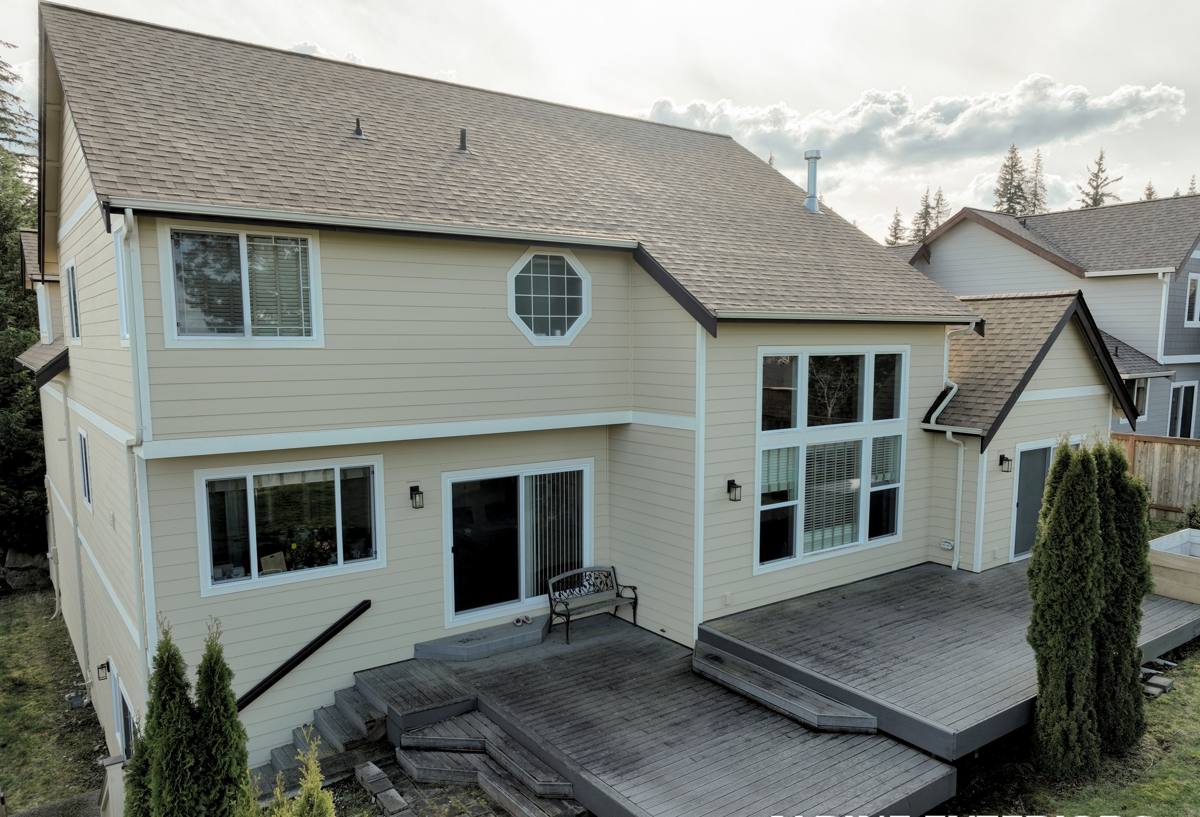
Why We Only Install James Hardie Fiber Cement in This Area
We install James Hardie fiber cement siding exclusively. We don't install vinyl, LP SmartSide, Cemplank, Allura, or primed wood siding, and that's a deliberate standard, not a lack of options. Fiber cement is made from cement, sand, and cellulose fiber, which gives it a set of properties that line up directly with what a Riverview home needs:
- Non-combustible — it won't ignite or contribute fuel to a fire, unlike wood-based siding products.
- Dimensionally stable — it doesn't expand, contract, warp, or buckle in Florida's heat swings the way vinyl can.
- Moisture-resistant core — it doesn't have an engineered-wood substrate that can swell or delaminate if water gets behind it.
- Factory-applied finish — the color and protective layer are baked on under controlled conditions, not brushed on in the field.
Vinyl siding is inexpensive and easy to install, and it has its place, but in direct, intense Florida sun it can fade unevenly and become brittle over time, and it's not built to take a wind-driven impact the way fiber cement is. Wood-based composite siding products perform reasonably well in drier climates, but their engineered-wood core is more sensitive to sustained humidity and any lapse in caulking or flashing — and lapses happen, even with careful installers, over the life of a house. We made the call years ago to standardize on one product system we trust to perform in this exact climate rather than offer several products and let the weather sort out which one was the right call.
The Right Hardie Product Line for Riverview Homes
HZ5 Climate-Engineered Formulation
James Hardie manufactures its siding in different formulations engineered for different climate zones. Homes in this part of Florida fall under Hardie's HZ5 specification, which is engineered specifically for high-humidity, high-moisture climates. It's a meaningful distinction — using a formulation engineered for a drier climate on a Tampa Bay area home is exactly the kind of shortcut that shows up as problems years later.
ColorPlus Technology
Hardie's ColorPlus finish is baked on at the factory in multiple coats under controlled conditions, which gives it better fade and wear resistance than field-applied paint and comes with its own finish warranty. For a home taking this much direct UV exposure, that factory finish is one of the biggest practical advantages over a product that has to be painted on site.
Lap, Panel, and Trim Options
Most Riverview homes are well suited to Hardie's lap siding profiles (smooth or cedar-textured), with Hardie trim boards used around windows, doors, corners, and fascia to complete the system. Some homes benefit from Hardie panel siding on accent areas like gables. We'll walk through which profile and color fit your home's existing lines and any HOA guidelines that apply.
What a Correct Installation Involves
Fiber cement siding performs the way it's supposed to only when it's installed to the manufacturer's specifications. This is the part homeowners can't see once the job is done, but it's the part that determines whether the siding lasts twenty-plus years or starts causing problems in five.
- Correct clearance between the bottom of the siding and grade, roofing, decks, and patios so water can't wick up into the material.
- A weather-resistant barrier installed underneath, lapped correctly to shed water downward and outward.
- Corrosion-resistant fasteners — stainless steel or hot-dip galvanized — driven at the correct depth and spacing, not overdriven or underdriven.
- Proper flashing at every window, door, and penetration, since these are the spots where wind-driven rain finds its way in first.
- Hardie-approved caulking and sealant at butt joints and trim intersections, not general-purpose caulk that breaks down in UV.
- Field-cut edges primed and painted before installation so no raw, unprotected material is left exposed.
- Adequate gapping and expansion joints where the manufacturer calls for them, even though fiber cement moves far less than vinyl.
Skip any one of these steps and the siding itself can still be excellent material — the failure just shows up as a workmanship problem instead of a product problem. This is why we treat installation detail as seriously as the product choice.
Our Process, Start to Finish
- On-site inspection and estimate — we look at your current siding, trim, and any signs of existing moisture or rot damage before quoting anything.
- Tear-off and substrate check — old siding comes off and we inspect the sheathing underneath for damage that needs to be addressed before new siding goes on.
- Repairs — any soft or rotted sheathing, trim, or framing is repaired or replaced; covering damaged substrate with new siding just hides a problem.
- Weather barrier and flashing — house wrap and flashing are installed and lapped correctly around every opening.
- Hardie siding installation — planks, panels, and trim go on to manufacturer spec, with correct fastening, clearances, and joint treatment.
- Finish work — caulking, touch-up painting of field cuts, and detail work around fixtures, vents, and utility penetrations.
- Final walkthrough and cleanup — we review the completed job with you and clear the site of debris and old material.
What Affects the Cost of a James Hardie Siding Job in Riverview
Every home is different, but the same handful of factors drive most of the price variation we see on jobs in this area:
| Cost Factor | Why It Matters |
|---|---|
| Home size and wall area | More square footage means more material and labor hours, the largest single driver of total cost. |
| Siding profile and texture | Smooth, cedar-textured, and panel options are priced differently and some require more detailed cutting and fitting. |
| Amount of trim and detail work | Homes with more windows, gables, and architectural detail need more trim work, which adds labor time. |
| Condition of the existing substrate | Rot or moisture damage found during tear-off means repair costs before new siding can go on. |
| Home accessibility | Multi-story sections, tight side yards, or landscaping obstacles can affect equipment needs and labor time. |
| Color selection | Standard ColorPlus colors are priced differently than custom or premium finish options. |
We break all of this down in the actual estimate for your home rather than quoting off a generic number — the factors above are why two similarly sized homes in the same neighborhood can land at different price points.
Warranty and Long-Term Value
James Hardie backs its siding with a transferable limited warranty, and the ColorPlus finish carries its own separate finish warranty covering fade and wear. That warranty coverage depends on the product being installed correctly to Hardie's specifications, which is another reason installation quality and product choice aren't really separate issues — a warranty is only as good as the install underneath it. Over the life of the siding, a factory finish that resists fading in constant Florida sun and a fiber cement core that resists moisture and pest damage translate into fewer repaint cycles and fewer surprise repairs than most alternative siding materials in this climate.
Why Hiring a Crew That Already Works in Riverview Matters
Siding installation isn't just about the product — it's about a crew that understands the conditions the material has to survive here. A crew that regularly works in Hillsborough County knows the wind and moisture demands Tampa Bay area homes face, understands the permitting process for exterior work in the county, and has already seen how different home styles and neighborhood aesthetic standards common in this area play into color and profile choices. That familiarity shows up in small decisions throughout a job — how flashing is detailed around a particular window style, how trim is handled at a roofline, how a color reads against Florida sun — that a crew unfamiliar with the area and its climate might not think twice about.
It also matters after the job is done. A local crew is easy to reach if a question comes up down the road, and stands behind its work in the same community it lives and works in.
Signs Your Siding Needs Attention
Whether you currently have fiber cement, wood, or vinyl siding, these are worth checking on a regular basis, especially after hurricane season:
- Visible cracking, warping, or buckling anywhere on the siding surface
- Soft spots or discoloration near the base of exterior walls, which can indicate moisture intrusion
- Paint or finish that's peeling, chalking heavily, or fading unevenly
- Gaps or separation at seams, corners, or trim joints
- Rust streaks near fasteners or trim fixtures
- Any musty smell or interior wall staining that could point to water getting behind the siding
Catching these early usually means a smaller repair. Waiting until damage is visible from the street usually means a bigger one.
If your Riverview home's siding is showing its age or you're planning ahead of the next storm season, we're happy to take a look and give you a straightforward, no-pressure estimate — no obligation, just an honest read on what your home actually needs.